Process Adherence and Process Analysis: Measuring Whether the Process Is Followed
A documented process that nobody follows is worse than none, because it creates a false sense of control. Measuring adherence tells you whether the process exists in practice, and analysis tells you whether it works.
Process adherence is the degree to which a process is followed as designed; process analysis examines how it performs. To measure adherence, define the standard path, capture evidence of each step, count deviations and review why they occur. In CoMng.AI the evidence comes from change requests, approvals, RACI roles, activity logs and audit logs.
- Adherence vs analysis: adherence asks "did we follow it?"; analysis asks "does it work?".
- Evidence beats attestation: measure from records, not from self-reports.
- Deviations are data: a high deviation rate means the process or its tooling needs fixing, not that people are careless.
- Delivery leaves a trail: change requests, approvals and audit logs record what happened.
Adherence and Analysis: Two Questions
| Process adherence | Process analysis | |
|---|---|---|
| Question | Was the process followed as designed? | Does the process deliver the outcome efficiently? |
| Looks at | Steps, approvals, evidence | Cycle time, waiting, rework, quality |
| Typical measure | Share of cases following the standard path | Time per step, delay, defect rate |
How to Measure Adherence
Define the standard path
Write the required steps, owners and approvals (see process mapping).
Capture evidence
Decide what record proves each step happened.
Count deviations
Cases that skipped or reordered a step.
Ask why
Deviations usually point to a too-slow, unclear or missing step.
Fix the process or the tooling
Make the compliant path the easy path.
Evidence in Project Delivery
| Process rule | Evidence in CoMng.AI |
|---|---|
| Changes are approved before being applied | Change request status and approval record; apply requires Approved |
| Someone is accountable | RACI matrix |
| Bulk or risky changes get extra care | Bulk-change flag set in code |
| Actions are traceable | Filterable audit logs |
| Work is logged | Activities log with time and cost |
| Decisions are recorded | Decisions stored in Project Settings lists and change requests |
CoMng.AI is a project delivery platform, not a general business process management suite. It manages the process of delivering projects (planning, change control, approvals, status, capacity). For enterprise-wide processes such as invoicing or onboarding, use a dedicated BPM or workflow tool.
Analysing Performance
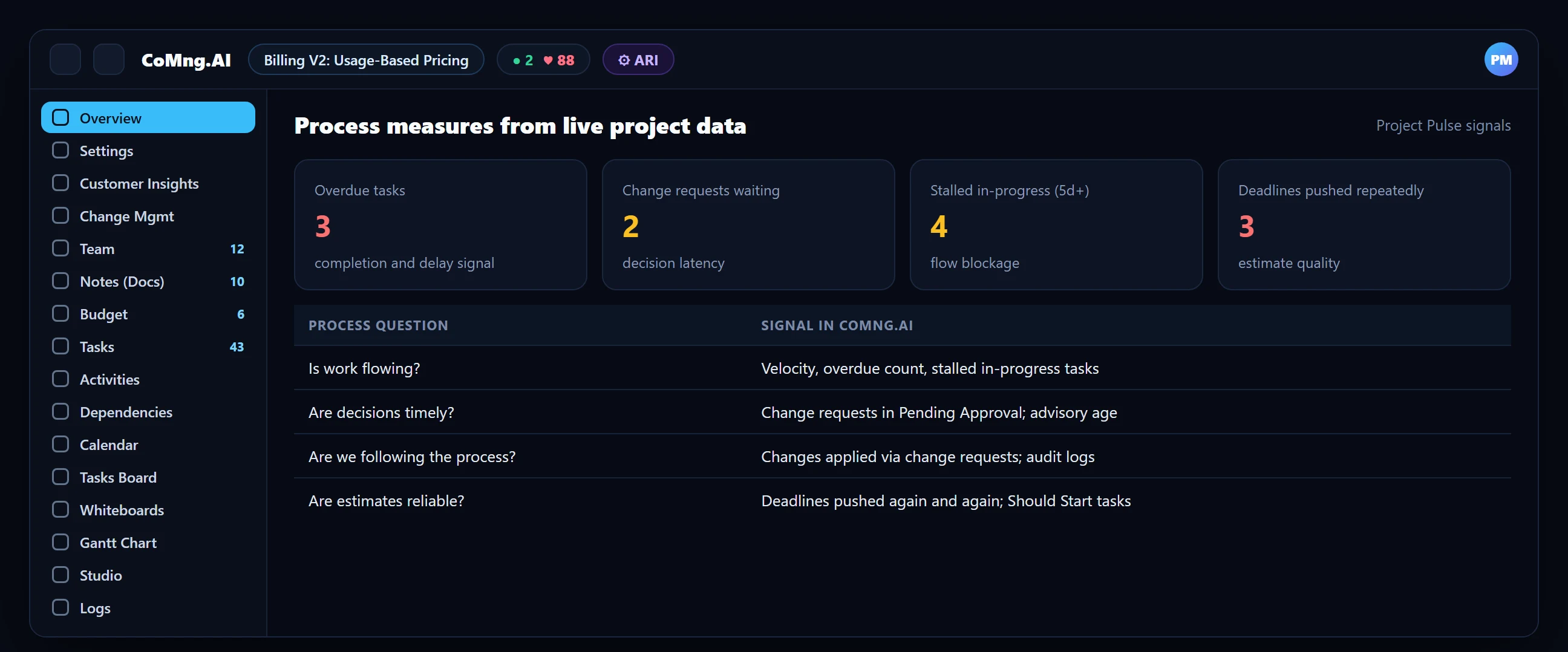
- Delay: overdue and stalled tasks, repeatedly pushed deadlines.
- Decision latency: change requests waiting for approval and advisories ignored for days.
- Slip: variance against a saved baseline.
- Capacity: weeks above 100% utilisation.
See improvement methodologies for what to do with the findings.
- Compliance by attestation
- Deviations hidden
- No view of where time goes
- Adherence from records
- Deviations counted and explained
- Delay and latency measured
About CoMng.AI
CoMng.AI is an AI-native project management platform that generates a project's plan, tasks, risks and budget from a description or document, monitors project health in real time, and gives both human teams and AI coding agents live access to the same project data, with a person approving every AI-generated change.
Make your project delivery process visible and measurable
Start free, map your change and approval flow, and let Pulse, change requests and audit logs show how it really runs.
Frequently Asked Questions
What is process adherence?
How closely a process is followed as designed.
How do you measure process adherence?
Define the standard path, capture evidence for each step from records, count deviations and investigate why they occur.
What is process analysis?
Examining how a process performs, for example its cycle time, waiting time, rework and quality, to find improvements.
What evidence of process adherence does CoMng.AI keep?
Change request records and approvals, RACI roles, bulk-change flags, audit logs and the activities log.
Why do people deviate from a process?
Often because it is slow, unclear or missing a case; treat deviations as signals about the process.
Related reading
See the full guide: Business Process & Process Management Guide