Process Improvement Methodologies: Lean, Six Sigma, PDCA, Kaizen and More
Process improvement methodologies are different lenses on the same question: why does this process cost more, take longer or fail more than it should? Choose the lens that fits the problem.
The main process improvement methodologies are Lean (remove waste), Six Sigma with DMAIC (reduce variation using data), PDCA (a plan-do-check-act improvement cycle), Kaizen (continuous small improvements) and the Theory of Constraints (fix the bottleneck). Pick by problem: waste and delay suggest Lean, inconsistency suggests Six Sigma, and a single bottleneck suggests the Theory of Constraints.
- Five lenses: Lean, Six Sigma, PDCA, Kaizen and the Theory of Constraints.
- Match method to problem: waste, variation, bottleneck or culture of improvement.
- Measure first: every method needs a baseline measure of the current process.
- Delivery data helps: Pulse signals and baselines give measures for project delivery processes.
The Main Methodologies Compared
| Methodology | Core idea | Best when |
|---|---|---|
| Lean | Remove waste (waiting, rework, over-processing, unused talent) to increase flow | Delay and handoffs dominate |
| Six Sigma (DMAIC) | Define, Measure, Analyze, Improve, Control: reduce variation using data | Results are inconsistent and measurable |
| PDCA | Plan, Do, Check, Act: a repeating cycle for testing changes | You want a light improvement loop |
| Kaizen | Continuous, small, everyday improvements by the people doing the work | You want a culture of improvement |
| Theory of Constraints | Find and exploit the single bottleneck that limits output | One step limits throughput |
Choosing the Right One
- Work waits between steps? Start with Lean and a value stream map.
- Results vary widely? Use DMAIC to find and control the causes.
- One queue limits everything? Apply the Theory of Constraints.
- Unsure and want to start small? Run a PDCA cycle on one step.
- Want it to stick? Build Kaizen habits into retros.
Every method starts with a map and a measure. See Process Mapping.
Measuring Improvement in Project Delivery
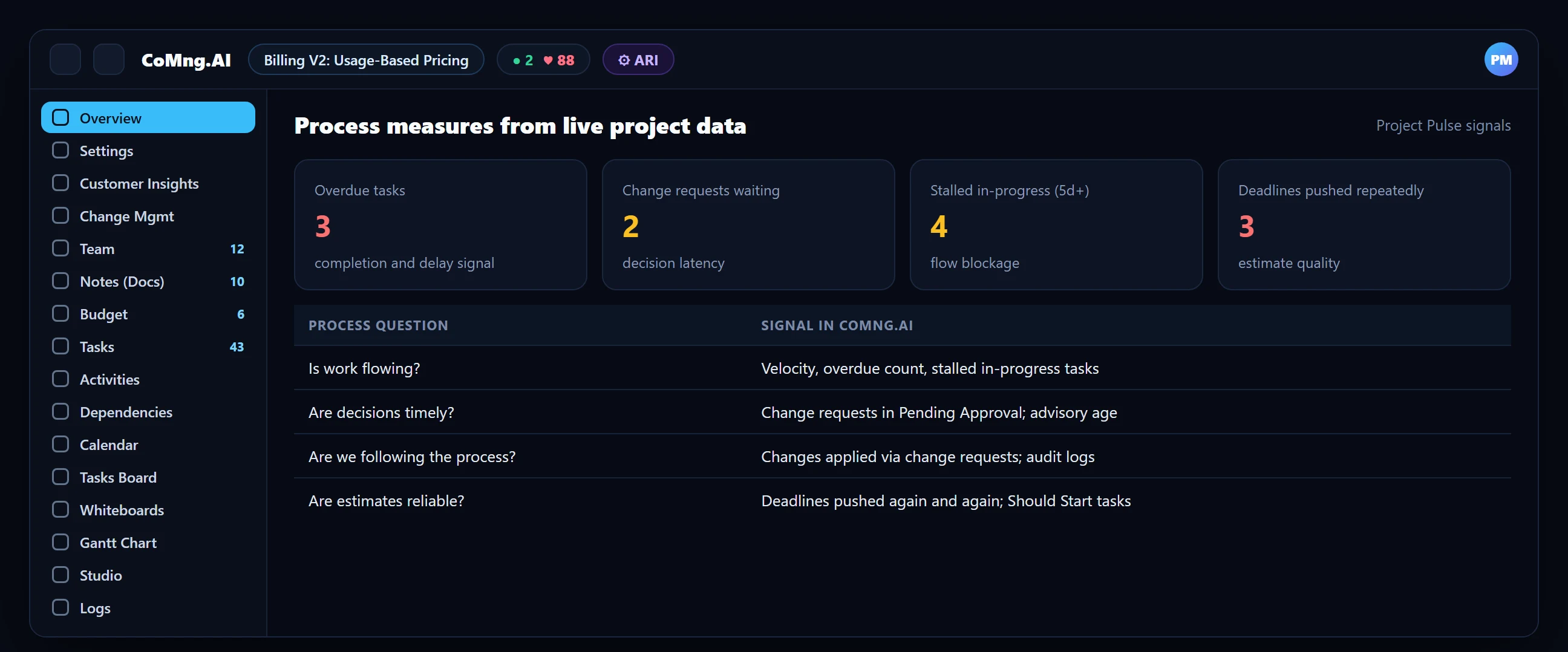
Project delivery produces its own process data. Project Pulse looks at overdue work, stalled in-progress tasks, change requests waiting for a decision and deadlines that keep being pushed, which are measures of flow, decision latency and estimate quality. A saved Gantt baseline measures schedule slip. Use these as your "Measure" step, then change one thing and watch them.
A Simple Improvement Loop for Delivery Teams
- Plan: pick one measure (for example change requests waiting more than a week).
- Do: try one change (for example a weekly approval slot).
- Check: compare the measure with the previous month.
- Act: keep, adjust or drop the change; record it.
Then check where your process sits on a maturity scale.
- Improvement by anecdote
- Changes with no measure
- Slip noticed at the review
- Improvement against a measured baseline
- One change at a time
- Slip visible on the Gantt baseline
About CoMng.AI
CoMng.AI is an AI-native project management platform that generates a project's plan, tasks, risks and budget from a description or document, monitors project health in real time, and gives both human teams and AI coding agents live access to the same project data, with a person approving every AI-generated change.
Make your project delivery process visible and measurable
Start free, map your change and approval flow, and let Pulse, change requests and audit logs show how it really runs.
Frequently Asked Questions
What are the main process improvement methodologies?
Lean, Six Sigma (DMAIC), PDCA, Kaizen and the Theory of Constraints.
What does DMAIC stand for?
Define, Measure, Analyze, Improve, Control.
Which methodology should I use?
Match it to the problem: Lean for waste and delay, Six Sigma for variation, the Theory of Constraints for a bottleneck, PDCA to start small, Kaizen for a continuous culture.
How do I measure improvement in project delivery?
Use measures such as overdue and stalled work, change requests waiting, schedule slip against a baseline and repeatedly pushed deadlines.
Can I combine methodologies?
Yes. Teams often use Lean to find waste, PDCA to test changes and Kaizen to keep improving.
Related reading
See the full guide: Business Process & Process Management Guide