Process Maturity Model: Five Levels and How to Assess Yours
Maturity models give you a common vocabulary for how reliably a process runs. They are most useful not as a score but as a map of what to do next.
A process maturity model describes how well-defined, consistent and measured a process is, commonly in five levels: ad hoc, repeatable, defined, measured and optimizing. To assess yours, check whether the process is written down, followed, measured with data and improved from those measures, then raise one level at a time.
- Five common levels: ad hoc, repeatable, defined, measured, optimizing.
- Assess honestly: ask whether the process is documented, followed, measured and improved.
- Climb one level at a time: skipping levels produces paperwork, not maturity.
- Data is the bridge: moving from defined to measured needs real delivery data.
The Five Levels
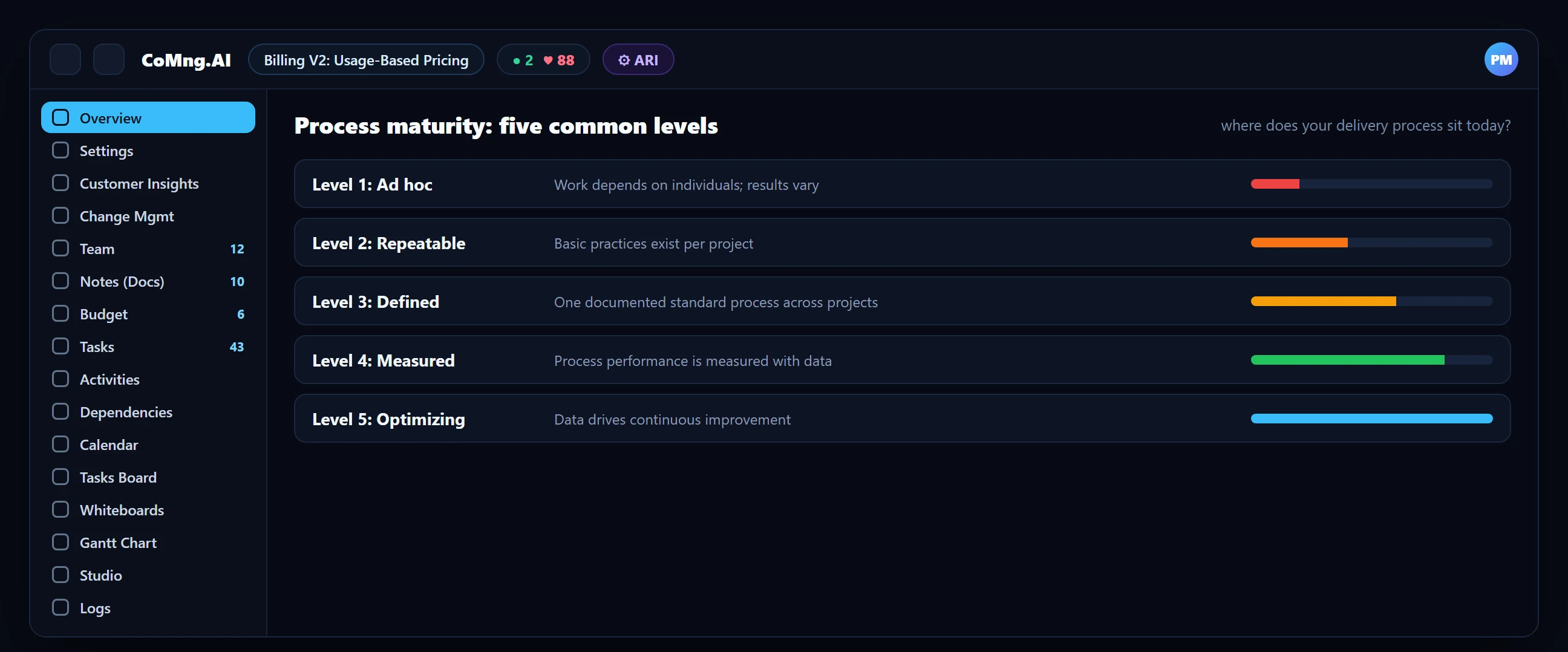
| Level | What it looks like | To move up |
|---|---|---|
| 1 Ad hoc | Results depend on individuals | Write down the basic steps |
| 2 Repeatable | Basic practices exist per project or team | Standardise across teams |
| 3 Defined | One documented standard process | Start measuring performance |
| 4 Measured | Performance tracked with data | Use the data to improve |
| 5 Optimizing | Continuous improvement driven by data | Sustain and extend |
These levels follow the shape used by well-known maturity models; specific models name them differently.
A Quick Self-Assessment
- Is the process written down and owned?
- Do different teams run it the same way?
- Do you measure its performance with data?
- Do you use that data to decide improvements?
- Do improvements reliably stick?
Your level is roughly the number of "yes" answers in order from the top.
Maturity of the Project Delivery Process
| Level | What it means for delivery | How CoMng.AI helps |
|---|---|---|
| Ad hoc | Plans and status vary by manager | Generate a plan from a document or description |
| Repeatable | Basic planning habits | Templates and framework generation |
| Defined | One standard way: scope, change control, approvals | Change requests, RACI, settings lists |
| Measured | Health and slip tracked with data | Pulse, baselines, milestone flags, Resource Planner |
| Optimizing | Data drives process changes | Trends, forecasts, retrospectives against baselines |
CoMng.AI is a project delivery platform, not a general business process management suite. It manages the process of delivering projects (planning, change control, approvals, status, capacity). For enterprise-wide processes such as invoicing or onboarding, use a dedicated BPM or workflow tool.
Related: Process Improvement Methodologies and The Strategic Shift Matrix.
- Maturity judged by feel
- Targets set without data
- Process changes forgotten
- A shared scale and self-assessment
- Targets tied to measures
- Improvements recorded and revisited
About CoMng.AI
CoMng.AI is an AI-native project management platform that generates a project's plan, tasks, risks and budget from a description or document, monitors project health in real time, and gives both human teams and AI coding agents live access to the same project data, with a person approving every AI-generated change.
Make your project delivery process visible and measurable
Start free, map your change and approval flow, and let Pulse, change requests and audit logs show how it really runs.
Frequently Asked Questions
What is a process maturity model?
A framework describing how defined, consistent and measured a process is, usually in five levels from ad hoc to optimizing.
What are the five levels of process maturity?
Ad hoc, repeatable, defined, measured and optimizing, as commonly described.
How do I assess process maturity?
Check whether the process is documented and owned, run consistently, measured with data and improved using that data.
Can I skip levels?
It is not advisable; each level builds the habits the next one needs.
How does project delivery maturity improve with CoMng.AI?
By moving from ad hoc plans to defined change control and approvals, then to measured health and baselines using Pulse and Gantt baselines.
Related reading
See the full guide: Business Process & Process Management Guide