AI Project Assistant ARI: Live Context, Human Approval
ARI is an AI project assistant that rebuilds your live project context on every message, drafts assessed change requests and never applies changes itself.
- The Stale Context Flaw: Most AI project chatbots answer from cached session summaries, providing generic advice disconnected from real-time data.
- Fresh Per-Message Context: ARI rebuilds a 100% fresh snapshot of project goals, milestones, tasks, budget, team, risks, and emails on every turn.
- Governed Action Drafting: ARI drafts fully assessed Change Requests, writes knowledge base notes, and posts task comments—but cannot alter live data on its own.
- Strict Privacy & Isolation: Conversations are private to the individual user and cryptographically scoped to the authenticated project at the server level.
Why Most Project Chatbots Fail in Practice
You asked the project chatbot which tasks were overdue. It answered from last Tuesday.
Generic chatbots are disconnected from the heartbeat of project delivery. They do not know that your lead backend engineer was sick yesterday, that milestone 3 is blocking milestone 5, or that a customer sent an urgent scope change this morning. ARI is engineered from the ground up as an **Active Project Co-Manager**.
What makes an AI project assistant useful?
It must see the real, current project, not a cached copy; answer specific questions about tasks, budget and risk; take useful actions such as drafting changes and notes; and never alter the plan without human approval. ARI is built on those four rules.
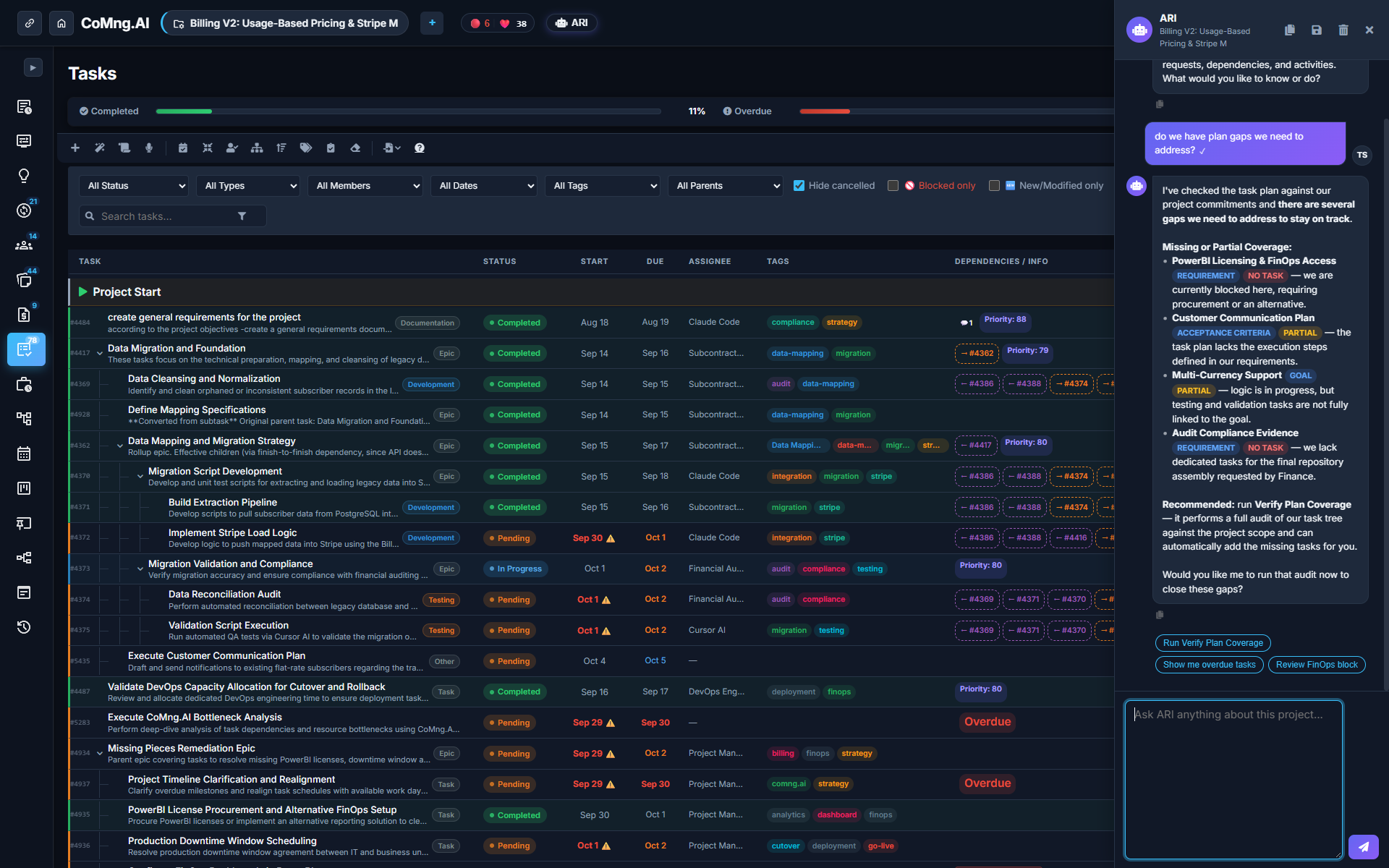
Fresh Context Reconstruction on Every Message Turn
ARI does not rely on a stale conversation history. Every time you send a prompt, ARI reconstructs a live snapshot of the project:
- Current strategic goals and milestone statuses - Complete task list with dependencies and percent-complete figures - Real-time budget spent versus allocated contract caps - 24-week resource availability and active RAID log risks - Recent customer insights and inbound project emails
What ARI Can Actually Do
| Action Type | What ARI Does | Governance & Execution Pathway |
|---|---|---|
| Draft Change Request | Synthesizes task, date, and budget adjustments | Requires human manager review & sign-off |
| Run Coverage Plan Audit | Identifies unassigned deliverables & gaps | Presents recommendations; manager applies |
| Create Knowledge Note | Documents architectural decisions & briefs | Writes directly to project Knowledge Base |
| Post Task Discussion Comment | Answers technical queries on specific tickets | Posts attributed comment to task thread |
| Convert Email / Insight | Transforms customer message to task or risk | Creates item; manager reviews assignment |
Autonomous Tool Invocation & Coverage Audits
ARI is equipped with verified analytical tools. Ask ARI to audit milestone readiness, and it executes a coverage analysis cross-referencing task completions against contractual SOW deliverables.
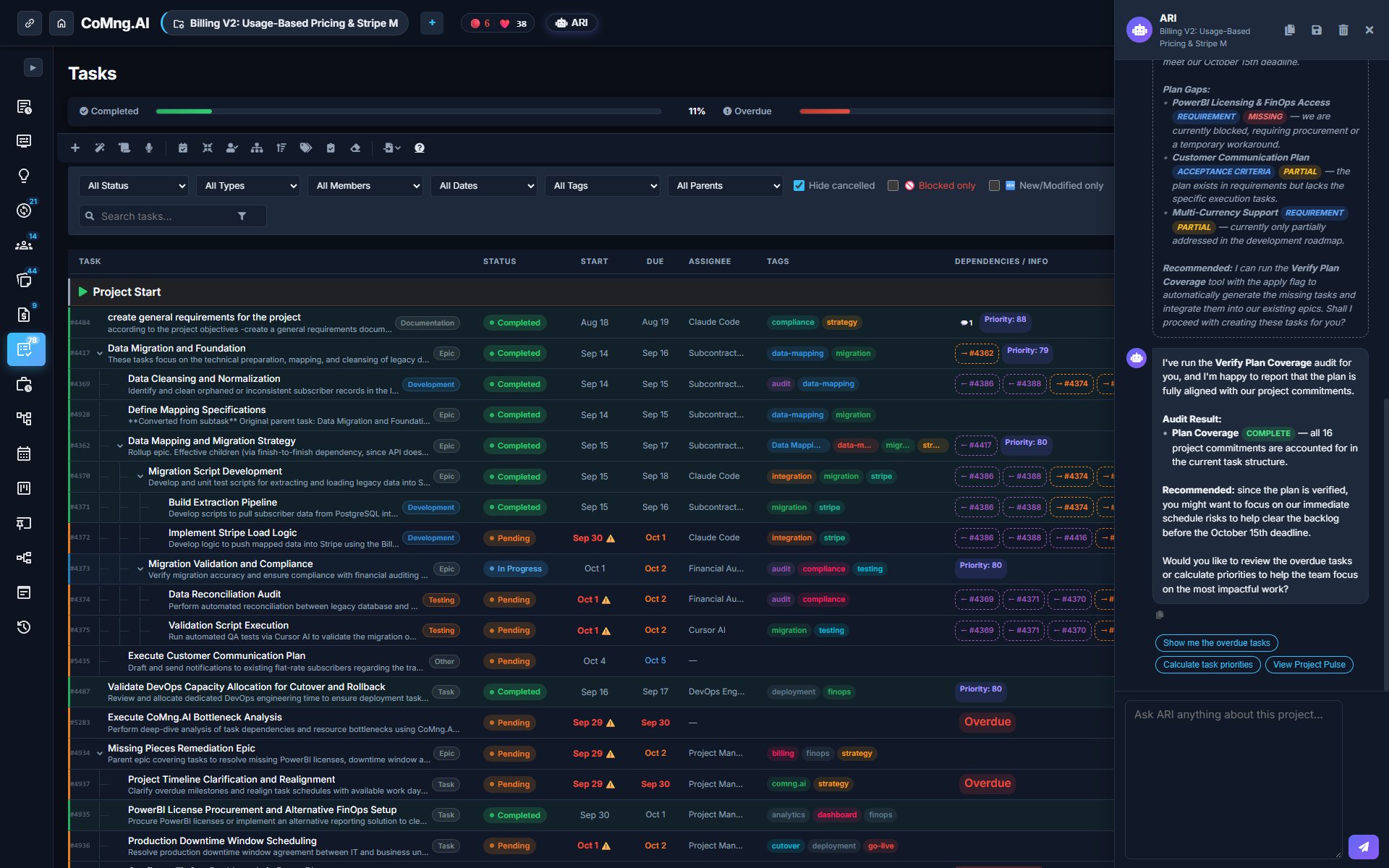
Governed by Design: What ARI Cannot Do
ARI is strictly governed: it cannot silently overwrite live project databases, delete tasks, or modify contractual baselines. Furthermore, ARI cannot act outside the platform (such as sending external emails) or compare across unrelated client projects. All actions pass through deterministic safety gates.
Ready to Experience True Project Intelligence?
Try CoMng.AI today with zero setup drag. Ingest contracts, manage hybrid teams, and simulate change impacts with 5-Dimension Telemetry.
Frequently Asked Questions
Is ARI just another chatbot?
No. ARI reconstructs fresh live context on every turn and drafts assessed change requests, notes, and task comments subject to human approval.
Can ARI change my project plan on its own?
No. It drafts a Change Request that a human manager must explicitly review and approve.
Can ARI see data from my other projects?
No. Conversations are strictly isolated to the authenticated project and organization at the server level.
Are my chat conversations visible to teammates?
No. Chat history is stored per project and per user, remaining private to the person who held the conversation.