Ask most people what “AI for project management” looks like and they describe the same thing: a chatbot you can ask questions, a tool that summarizes your meetings, a feature that auto-generates task titles when you start typing. Useful, sure. But useful in the same way a calculator is useful – it saves you a few steps, but you are still doing all the thinking.
That is an AI project assistant. And for the past several years, it has been the dominant form of AI in project management software.
Something fundamentally different has emerged. Not an assistant that responds to your questions, but an AI co-manager for projects that monitors your project autonomously, reasons about what is happening, flags problems before you notice them, generates the documents your project needs, and frees you to lead rather than administrate. Not a tool you use. A system that works alongside you.
The difference between the two is not a matter of degree. It is a difference in category – and understanding it is the most important decision a project manager or team leader will make in 2026 when choosing how to work with AI.
The core distinction: reactive vs. autonomous
The simplest way to understand the difference between an AI project assistant and an AI co-manager is this:
An AI project assistant is reactive. It waits for you to ask something, then answers.
An AI co-manager is autonomous. It monitors your project continuously, decides what matters, and acts – without waiting to be asked.
This is not a subtle distinction. It changes what you spend your time doing, what you are responsible for thinking about, and what falls through the cracks when you are busy doing other work.
An assistant requires you to know what to ask. If you do not know that your critical path has a dependency conflict in week four, you will not ask about it, and the assistant will never tell you. The problem exists, silently, until it becomes a crisis.
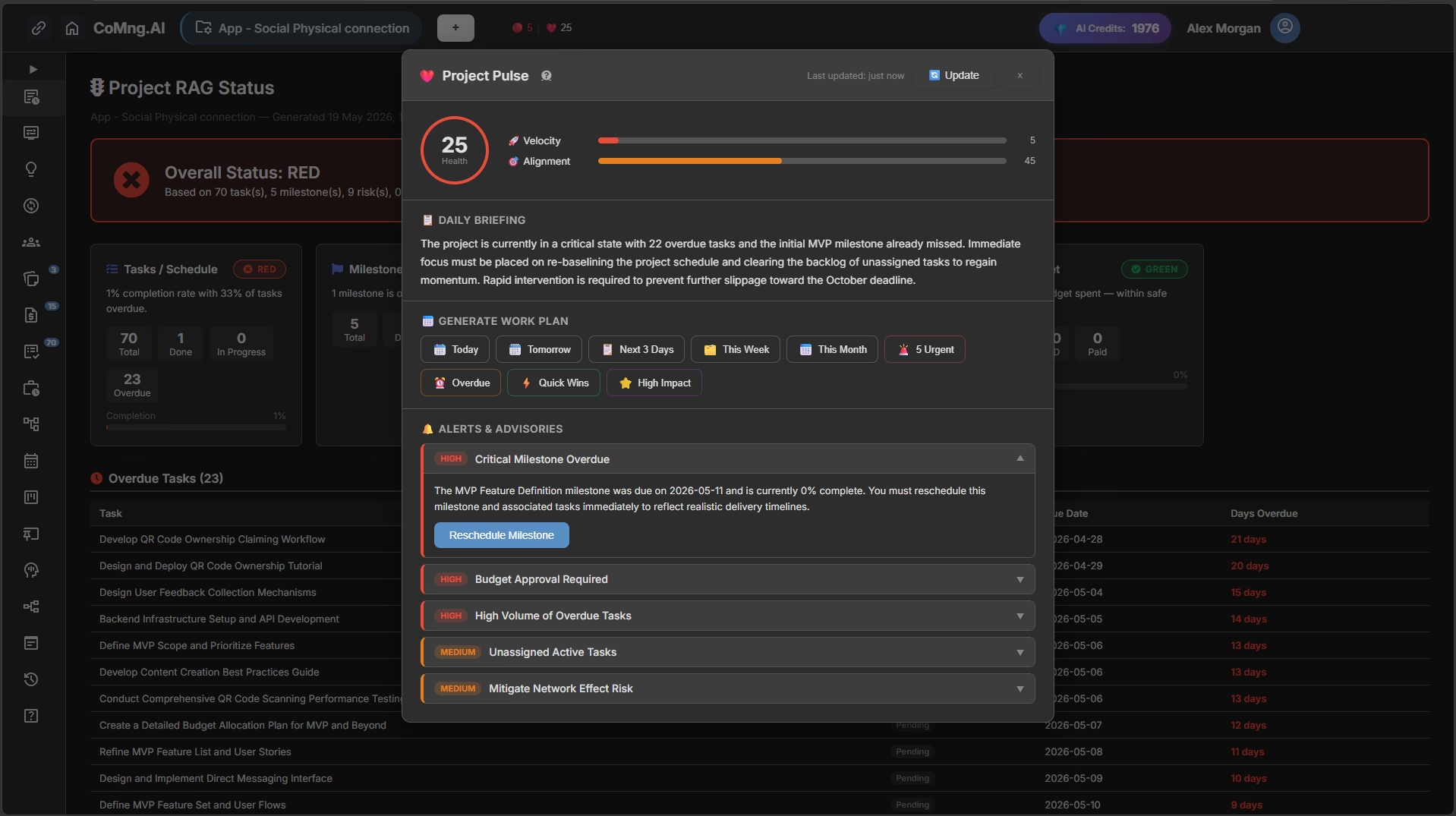
An AI co-manager for projects does not wait for your question. It reads the project, identifies the dependency conflict, understands that it is on the critical path, and surfaces it as a priority action – whether you asked or not. This is what autonomous project management AI means: the system has agency. It observes, reasons, and initiates – not just responds.
What an AI project assistant actually does
To be precise about the comparison, it is worth being specific about what AI project assistants – as they currently exist in most project management tools – actually do well.
Answering questions about your project
Ask “what tasks are due this week?” and an AI assistant pulls the list. Ask “summarize the last meeting notes” and it produces a summary. These are valuable functions. They reduce the time you spend hunting for information.
The limitation is that every one of these functions requires you to initiate. You need to know what to look for, when to look, and how to phrase the question. The AI is a search interface with natural language – sophisticated, but still fundamentally a lookup tool.
Generating content when prompted
Most AI-enabled project tools in 2025 can generate a task description if you give them a task title, write a status update if you feed them data, or draft a meeting agenda if you describe what needs to be covered. Again, useful – but everything the AI produces begins with a human prompt.
The project still needs a human to hold its structure in their head: to know which tasks exist, which risks matter, which stakeholders need updates, and when. The AI produces content. The project manager produces judgment.
Automating repetitive mechanics
Some AI project tools automate scheduling, send reminders, or flag overdue tasks. These are rule-based automations dressed in AI language – genuinely time-saving, but not intelligent in any meaningful sense. They do not understand your project. They execute rules.
What an AI co-manager for projects actually does
An AI co-manager operates at a categorically different level. Rather than responding to inputs, it maintains continuous awareness of the project and acts on what it understands.
CoMng.AI is built on this model – described on its homepage not as a project management tool or a task tracker, but as an AI Co-Manager that thinks, plans, and executes alongside you. The distinction is deliberate and structural, not marketing language. Here is what it means in practice.
It generates the entire project structure from a description
When you create a project in CoMng.AI, you describe what you want to accomplish in plain language. The AI Co-Manager generates the complete project framework: strategic goals, success metrics, milestones with realistic dates, 100+ tasks with effort estimates and dependencies, identified risks with mitigation strategies, budget line suggestions, and recommended team roles.
This is not content generation triggered by a prompt. It is AI project execution software reasoning about what a project of this type requires – drawing on patterns across project structures, industry knowledge, and dependency logic – and producing a complete, coherent operational plan. A senior project manager reviewing the output would recognize it as the product of serious project thinking, not template-filling.
The practical impact: project planning that previously took three weeks of workshops and stakeholder interviews now takes minutes. Not because shortcuts were taken, but because the AI Co-Manager did the work.
It monitors the project continuously without being asked
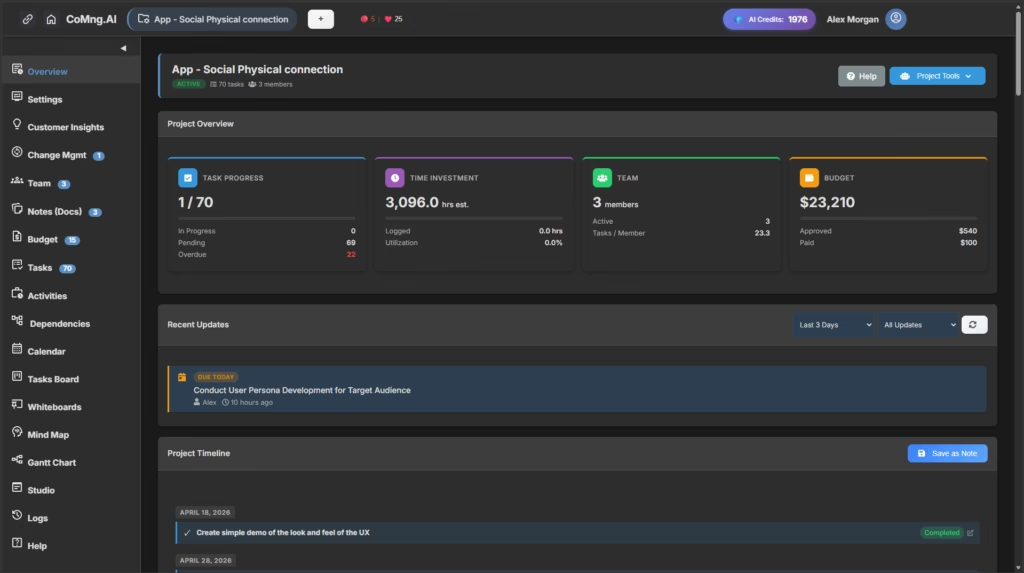
Every day, as your team logs hours, completes tasks, updates statuses, and records budget entries, CoMng.AI’s AI Co-Manager reads the evolving state of your project. It is not waiting for a prompt. It is maintaining a living understanding of what is happening.
When you open the Overview Dashboard, you are seeing the output of this continuous monitoring: task completion rates against the baseline, time investment versus estimates, team utilization, budget burn, and critical path status – all current, all interpreted, none requiring manual compilation.
This is the heartbeat of autonomous project management AI: it is always running, always aware, and always ready to surface what matters without you having to ask.
It proactively surfaces problems and priorities
The Personal Advisor – CoMng.AI’s built-in AI analysis interface – does not wait for you to ask “how is the project doing?” When you click Analyze Project Status, it delivers a complete assessment of your project’s current condition: tasks at risk, approaching deadlines, resource overallocation, budget variance, and critical path conflicts.
Critically, it identifies the critical path – the exact sequence of tasks that determines your earliest possible completion date – and flags when anything on that path is in jeopardy. A two-day slip on a non-critical task is logged and noted. A two-day slip on a critical path task becomes a priority warning, because the AI Co-Manager understands the difference.
This proactive, prioritized awareness is the operational definition of agentic project management: the AI has enough understanding of your project to decide what deserves your attention, rather than presenting everything equally and leaving all judgment to you.
It generates documents from live project data – without a prompt
Every professional communication a project generates – status reports, executive summaries, client updates, risk assessments, budget justifications, kickoff emails, presentations – requires someone to sit down and write it. That person is usually the project manager. And those documents consume a disproportionate share of the project manager’s week.
CoMng.AI’s AI Co-Manager treats documentation as part of its autonomous function. The Report Generator produces complete, narrative-driven reports from live project data – not templates populated with numbers, but documents that explain what the numbers mean, why the situation is what it is, and what needs to happen next.
The Composer generates professional project communications: kickoff emails, stakeholder updates, budget justification letters, meeting agendas – each drawing from the live state of your project so the content is accurate to today, not to last Thursday’s export.
An AI project assistant writes when you tell it to write, about what you tell it to write about. An AI co-manager for projects produces documentation as a natural output of its ongoing project awareness – because it already knows everything the document needs to contain.
The agentic project management model – why 2026 is the turning point
The term agentic has moved from research papers into mainstream product design over the past 18 months. An agentic AI system is one that can set goals, plan multi-step actions, execute those actions, and adapt based on what it observes – without a human directing each step.
Applied to project management, agentic AI means a system that can:
- Understand the project’s objectives
- Monitor progress toward those objectives continuously
- Identify deviations, risks, and opportunities without being asked
- Take action – generating reports, surfacing warnings, recommending adjustments – based on its own analysis
- Learn from the project’s evolving state and refine its understanding over time
This is precisely what separates agentic project management from traditional project software, even AI-enhanced traditional software. The difference is not the AI feature set – it is where the agency lives.
In traditional project software (including most “AI-powered” tools), the agency lives with the project manager. The PM decides what to look at, what to ask, what to generate, what to escalate. The software responds to those decisions.
In an agentic system like CoMng.AI, the agency is distributed. The AI Co-Manager holds genuine responsibility for monitoring, analysis, and communication – and exercises that responsibility continuously, not when prompted. The project manager retains authority over decisions and strategy. But the operational burden of constant vigilance shifts to the AI.
A practical comparison: the same week, two different systems
To make this concrete, consider what a project manager’s week looks like with each type of AI.
With an AI project assistant
Monday morning: the PM opens the project tool, manually reviews task status, identifies that three tasks are overdue, and writes up a status update to share with the team. The AI assistant, if asked, would help format the status update or summarize the task list – but it did not notice the overdue tasks on its own.
Wednesday: a dependency conflict between two tasks becomes apparent because one task finished early and its dependent task’s owner has not been notified. The AI assistant did not flag this – dependency conflicts are not in its monitoring brief.
Friday: the weekly client report is due. The PM compiles data from the dashboard, exports a few charts, writes the narrative, and sends it 90 minutes later. The AI assistant helped format one paragraph when asked.
The PM spent approximately 4 hours on reporting and monitoring this week, on top of actual project work.
With CoMng.AI – an AI co-manager for projects
Monday morning: the PM opens CoMng.AI. The Overview Dashboard shows current project health at a glance. The Personal Advisor has already identified that three tasks are overdue and flagged one of them as being on the critical path – with a specific recommendation. The PM spends 10 minutes reviewing the analysis, makes two decisions, and moves on.
Wednesday: CoMng.AI’s critical path analysis surfaces the dependency resolution automatically in the PM’s next Personal Advisor check. The relevant team member receives the update.
Friday: the PM opens the Report Generator, selects the client report template, clicks Generate, reviews the AI-written narrative in five minutes, adds one paragraph of strategic context, and sends it. Total time: 12 minutes.
The PM spent approximately 35 minutes on reporting and monitoring this week. The rest went to actual leadership.
How CoMng.AI is built as an AI co-manager – not a project assistant
CoMng.AI describes itself as “the world’s first AI-integrated project framework – an Autonomous Execution System.” Each word in that description corresponds to a specific architectural choice that differentiates it from assistant-model tools.
Autonomous: the system operates continuously, not on demand. Project data is always being read. Analysis is always current. You do not turn the AI on – it is always on.
Execution: the AI does not just plan or advise – it produces outputs that drive execution: task structures, dependency maps, risk assessments, reports, communications. These are not suggestions for what you might create. They are the created things themselves.
System: CoMng.AI is not a feature added to a traditional tool. It is a complete project operating system where every function – planning, tracking, communication, reporting, risk management, budgeting – is integrated and AI-native from the ground up.
This architecture is what makes it AI project execution software in the genuine sense: not software that helps humans manage projects, but software that executes the operational functions of project management autonomously, leaving the human to lead.
Who needs an AI co-manager vs. who is fine with an AI assistant
Both categories of tool serve real needs. The right choice depends on what the project manager’s actual bottleneck is.
An AI project assistant is sufficient when:
- Projects are small, short, and low-complexity
- The PM has time to monitor actively and can afford to initiate all AI interactions
- The primary need is content generation (status updates, meeting summaries) rather than autonomous monitoring
- The team is not drowning in documentation overhead
- The cost of a missed risk or late flag is relatively low
Tools like Notion AI, ClickUp’s AI features, and Asana Intelligence fall broadly into this category – AI layered on top of traditional project management mechanics.
An AI co-manager for projects is needed when:
- Projects are complex, long-running, or high-stakes
- The PM is running multiple projects simultaneously and cannot monitor each one continuously
- Documentation overhead is consuming disproportionate PM time
- Missed risks or delayed escalations have real consequences
- The organization wants consistent project quality regardless of which PM is assigned
- Enterprise project leads, PMO directors, or citizen managers (non-traditional PMs running projects outside their core function) need leverage that a tool-plus-human model cannot provide
This is the audience CoMng.AI is built for: enterprise project leads managing complex multi-stakeholder initiatives, PMO directors overseeing portfolios, and citizen managers who are excellent at their core discipline but not trained project managers – and who need an AI Co-Manager to handle the project mechanics so they can focus on the work.
The AI project manager tool landscape in 2026
The market for AI project manager tools in 2026 is undergoing a meaningful segmentation. After two years of every project tool adding “AI features” – primarily chatbots, auto-summarization, and prompt-triggered content generation – a clearer distinction is emerging between tools that added AI to project management and tools that built project management on AI.
The assistant-model tools are widespread, improving, and appropriate for a large portion of the market. They will continue to get better at the tasks they do: answering questions, drafting content, and automating rules.
The co-manager model – autonomous, agentic, execution-oriented – is where the frontier is moving. The teams and organizations adopting it in 2026 are not choosing a better task tracker. They are restructuring how project work gets done: shifting operational burden from human bandwidth to AI autonomy, and reclaiming PM time for the judgment, leadership, and relationship work that no AI can replace.
CoMng.AI’s position in this landscape is explicit. Its tagline is not “smarter project management.” It is: Stop being a project administrator. Start being a project leader. That distinction – administrator versus leader – is exactly what the co-manager model makes possible.
FAQ: AI co-managers, autonomous project management, and agentic AI
What is an AI co-manager for projects? An AI co-manager for projects is an AI system that shares operational responsibility for project management functions – monitoring, analysis, documentation, and risk identification – continuously and autonomously, without waiting for human prompts. Unlike an AI assistant that responds to questions, an AI co-manager maintains live awareness of the project and acts on that awareness proactively. CoMng.AI is built on this model, describing itself as an AI Co-Manager that thinks, plans, and executes alongside the human project manager.
What is autonomous project management AI? Autonomous project management AI refers to AI systems that execute project management functions independently – generating plans, monitoring progress, identifying risks, and producing documentation – rather than simply assisting human PMs with individual tasks when prompted. The term “autonomous” indicates that the AI has agency: it decides what to do based on its understanding of the project, rather than waiting for instructions.
What is agentic project management? Agentic project management is the application of agentic AI – AI that can set goals, plan multi-step actions, and execute them without step-by-step human direction – to the domain of project execution. In agentic project management, the AI understands project objectives, monitors progress toward them, identifies deviations, and takes initiative to surface and address problems. CoMng.AI’s Personal Advisor, critical path analysis, and autonomous report generation are all expressions of agentic project management in practice.
How is an AI co-manager different from an AI project assistant? The core difference is reactive versus autonomous. An AI project assistant responds to prompts – it answers questions, generates content when asked, and automates specific rules. An AI co-manager monitors the project continuously, reasons about what matters, and acts proactively without being asked. The practical result is that an AI assistant reduces the time individual tasks take, while an AI co-manager eliminates entire categories of work – monitoring, documentation, risk identification – from the PM’s weekly schedule.
Is CoMng.AI an AI project manager tool? CoMng.AI is an AI Co-Manager – a distinction it draws deliberately. A project manager tool helps humans manage projects. CoMng.AI co-manages projects alongside the human: it holds genuine operational responsibility for planning, monitoring, analysis, and documentation, while the human retains authority over decisions and strategy. In practice, CoMng.AI functions as AI project execution software – producing the operational outputs of project management autonomously, from complete project plans to stakeholder-ready reports.
Who should use an AI co-manager vs. a traditional AI-assisted project tool? Teams running simple, low-complexity projects with active PM oversight can get significant value from AI-assisted project tools – AI features layered on traditional project management software. Teams running complex, multi-stakeholder, or high-stakes projects – or project managers running multiple projects simultaneously – need the autonomous monitoring, proactive risk identification, and continuous documentation that an AI co-manager provides. Enterprise project leads, PMO directors, and citizen managers who are not trained PMs are the primary audiences for the co-manager model.
What to look for in an AI co-manager for projects in 2026
If you are evaluating AI project management tools this year, the question to ask is not “what AI features does this have?” It is “where does the agency live – with me or with the system?”
A checklist for genuine AI co-management capability:
- Does the AI generate the entire project structure from a description, or does it just help fill in fields?
- Does the AI monitor the project continuously, or only when you open a specific view or run a specific command?
- Does the AI proactively surface risks and blocked dependencies, or does it only show what you ask it to show?
- Does the AI generate complete, narrative-driven reports from live data, or does it populate templates?
- Does the AI understand critical path and project baseline – or does it just track tasks?
- Is AI integrated into every function (planning, budgeting, risk, reporting, communication) from the ground up – or is it a layer added on top of a traditional tool?
If the answer to most of these is “only when you ask it to,” you are looking at an AI assistant. If the answers are “continuously” and “automatically,” you are looking at an AI co-manager.
See CoMng.AI’s AI Co-Manager in action – free, no credit card required →
Related reading
- The full features list: what CoMng.AI’s AI Co-Manager does – a comprehensive breakdown of every capability in the platform
- Who is CoMng.AI for? Enterprise leads, PMO directors, and citizen managers – understanding which teams benefit most from the co-manager model
- Automated Reporting with AI: The Complete Guide – how CoMng.AI’s autonomous report generation works in practice
- AI Generated Reports: How to Automate Your Reporting Process – the full breakdown of report types, templates, and export options
CoMng.AI is the world’s first AI-integrated project framework – an Autonomous Execution System that co-manages your project budget, baseline, and documentation so you can lead instead of administrate.