If you’ve been searching for “AI co-manager software” or wondering how an AI co-manager differs from an AI assistant, this post is for you.
The term is new. The problem it solves is not.
The Terminology Problem
Every few years, a new product category gets a name before the market fully understands what it means. “Cloud computing.” “Low-code.” “AI assistant.” Each of these terms landed in a world that wasn’t quite ready for them – and had to do the hard work of explaining itself.
AI co-manager is having that moment right now.
So let’s define it clearly, because conflating it with an AI assistant – or worse, an AI-powered task tracker – misses the entire point.
What Is an AI Co-Manager?
An AI co-manager is an autonomous software system that takes on a genuine managerial role alongside a human. It doesn’t just respond to prompts. It doesn’t surface information and wait. It reasons about a situation, identifies what needs to happen, and acts.
The “co-” prefix is load-bearing. This is not a replacement for human judgment – it’s a peer in the management process. A co-manager AI:
- Maintains a full understanding of the project at all times
- Generates plans, identifies risks, and flags issues without being asked
- Drafts documents, structures teams, and updates work systems autonomously
- Monitors health metrics and alerts proactively – not reactively
- Makes recommendations with full awareness of context, constraints, and dependencies
In short: it manages with you, not just for you on isolated tasks.
AI Co-Manager vs. AI Assistant: A Real Distinction
This is the comparison that matters most, so let’s be direct.
An AI assistant – whether that’s ChatGPT, Copilot, Notion AI, or any embedded AI feature in a productivity tool – operates on a simple model: you ask, it answers. You prompt, it generates. You move on. It waits.
An assistant is reactive by design. Its value is proportional to the quality of your prompts and your ability to act on the outputs.
An AI co-manager inverts this model.
| AI Assistant | AI Co-Manager | |
|---|---|---|
| Initiates action? | Never | Yes – proactively |
| Maintains context? | Per-conversation only | Persistent, cross-module |
| Aware of project health? | No | Yes – continuously |
| Generates structured plans? | On request | Autonomously, on a trigger |
| Takes action in your system? | Rarely | Yes – updates boards, drafts docs, alerts teams |
| Understands dependencies? | Not by default | Built-in |
| Replaces manual workflows? | Partially | Substantially |
The analogy: an AI assistant is like a very capable intern who answers when called. An AI co-manager is like a seasoned operations lead who has read every document, attends every standup mentally, and taps you on the shoulder when something needs attention – without being asked.
Why the Gap Between “AI in PM Tools” and “AI Co-Manager” Matters
Every major project management platform now has AI features. Jira has AI-generated summaries. Asana has AI task suggestions. Notion has an AI writing assistant. Monday.com surfaces AI-powered automations.
These are valuable additions. They’re also not what we’re describing.
The gap is this: all of these tools use AI to help you do things inside the tool. The human is still the project manager. The AI reduces friction in specific tasks but leaves the full cognitive load of project management with the person.
An AI co-manager changes the ownership model of project execution.
When you describe a project to a true AI co-manager, it:
- Scaffolds the entire project structure – goals, milestones, requirements, risks, scope, roles, assumptions – without you filling in a single field
- Activates a live health monitoring system – tracking velocity, sentiment, and alignment continuously, not just when you remember to check
- Generates autonomous work plans – today’s tasks, urgent items, quick wins, high-impact actions – on demand or on schedule
- Assembles team recommendations – identifying required roles, skill gaps, and creating job descriptions or SOWs automatically
- Acts across every module simultaneously – not siloed to one feature
This is what CoMng.AI calls an Autonomous Execution System (AES) – a new product category distinct from PM tools, AI copilots, and workflow automation platforms.
What an Autonomous Co-Manager AI Actually Does in Practice
Here’s a concrete walkthrough.
You open CoMng.AI. You type: “We’re launching a mobile loyalty app for a retail chain. MVP in 4 months. Small cross-functional team.”
Within seconds, the system has generated:
- A goal structure with success metrics
- A milestone timeline with dependencies
- A full RAID+ register (Risks, Assumptions, Issues, Dependencies)
- Functional and non-functional requirements
- Stakeholder and role definitions
- A scope boundary document
- Tasks with estimated effort, costs, subtasks, and AI-powered insights
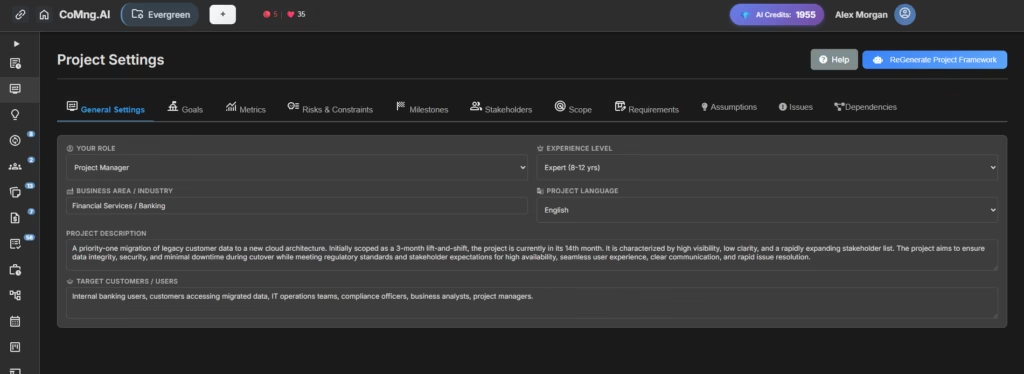
You haven’t clicked a single setup field.
The Project Pulse activates immediately – a live health score composed of Velocity, Sentiment, and Alignment. A daily briefing tells you what matters today. HIGH, MEDIUM, and LOW priority alerts tell you what needs attention right now (Team Formation Required. Budget Definition Needed. MVP Feature Definition.).
The Autonomous Workplan Engine lets you generate today’s tasks, this week’s priorities, quick wins, or overdue items – in one click, any time.
The Team Assembly Engine suggests which roles you need, identifies skill gaps, and lets you create a job description or Statement of Work for each role directly from the suggestion card.
The Studio/Composer drafts your kickoff email, your project brief, your status report – in full project context, not from a template.
None of this required a prompt. None of it required configuration. The AI reasoned from your description and acted.
Who Needs AI Co-Manager Software?
The honest answer: anyone who manages projects at any level of complexity – and is tired of the gap between having a plan and executing it.
The gap is real. Project management software has become extremely good at storing information about projects. It has become almost completely useless at running them. The burden of thinking, connecting, prioritizing, and alerting still falls entirely on the human PM.
That is the problem AI co-manager software is designed to close.
If you’re a:
- Project manager drowning in status updates and coordination overhead, spending less than half your time on actual strategic decisions
- Startup founder or product lead who needs to run multiple workstreams without a full PM function
- Agency or consultancy managing client projects where speed of setup and documentation quality directly affects perception
- Engineering or operations team lead who needs execution infrastructure without the ceremony
…then AI co-manager software is worth serious evaluation.
The Category Is New. The Need Isn’t.
For decades, the PM industry has produced better and better tools for organizing information about work. Gantt charts. Kanban boards. Burndown charts. OKR trackers. Sprint ceremonies.
All of it still requires humans to do every bit of the reasoning.
AI co-managers represent the first genuine shift in that model – not AI that helps you work faster inside a tool, but AI that takes on the work of managing the project itself, alongside you.
CoMng.AI was built to define this category: Autonomous Execution Systems for project delivery. MCP-ready, API-first, with 20+ integrated AI-native modules operating from a single intelligence layer.
If you’re ready to see what an AI co-manager actually looks like in practice, try CoMng.AI at comng.ai.
CoMng.AI is the Autonomous Execution System for modern teams – not a PM tool, not a copilot. An AI that co-manages your projects from inception to delivery.